Not every fastener is the same, and neither is every application — which is why selecting the correct impact driver bits for each specific job is a skill that separates experienced professionals from those who damage materials, strip fasteners, and waste time on rework. This practical guide covers the key decisions involved in matching bits to applications, helping you build a bit selection that handles every scenario your work throws at you.
The starting point for any bit selection decision is the drive type of the fastener you are working with. Phillips and Pozidriv bits dominate in general woodworking, decking, and drywall applications. Torx (also known as star drive) bits are the preferred choice in furniture assembly, automotive, and many electronics applications because the six-point star geometry provides superior torque transfer with minimal cam-out tendency. Hex (Allen) bits are common in machinery assembly and furniture flatpack work. Robertson (square drive) bits are dominant in Canadian construction and are increasingly used in North American timber framing for their exceptional cam-out resistance. Identifying the drive type correctly before starting a job is the most fundamental step in bit selection.
Matching Bit Length to the Application
Bit length is often overlooked but critically important. Standard 25 mm bits are ideal for use in compact bit holders or quick-change chucks where minimal stick-out is desired — perfect for tight-access areas or when precision placement of the fastener is critical. 50 mm bits offer a good balance between reach and stability for most general-purpose applications. Longer bits — 75 mm, 90 mm, and 150 mm — are essential for reaching recessed fasteners, driving screws into deep cavities, or working in cramped spaces where the impact driver itself cannot be positioned directly above the fastener.
Torsion-zone or "bamboo joint" bits incorporate a deliberately flexible zone in the shank that absorbs some of the rotational impact energy before it reaches the tip. This design reduces tip wear and cam-out tendency, particularly valuable for high-torque applications or when working with self-tapping metal screws that require sustained driving force. If you regularly drive screws into metal or dense hardwood, torsion-zone bits will extend your bit replacement interval significantly.
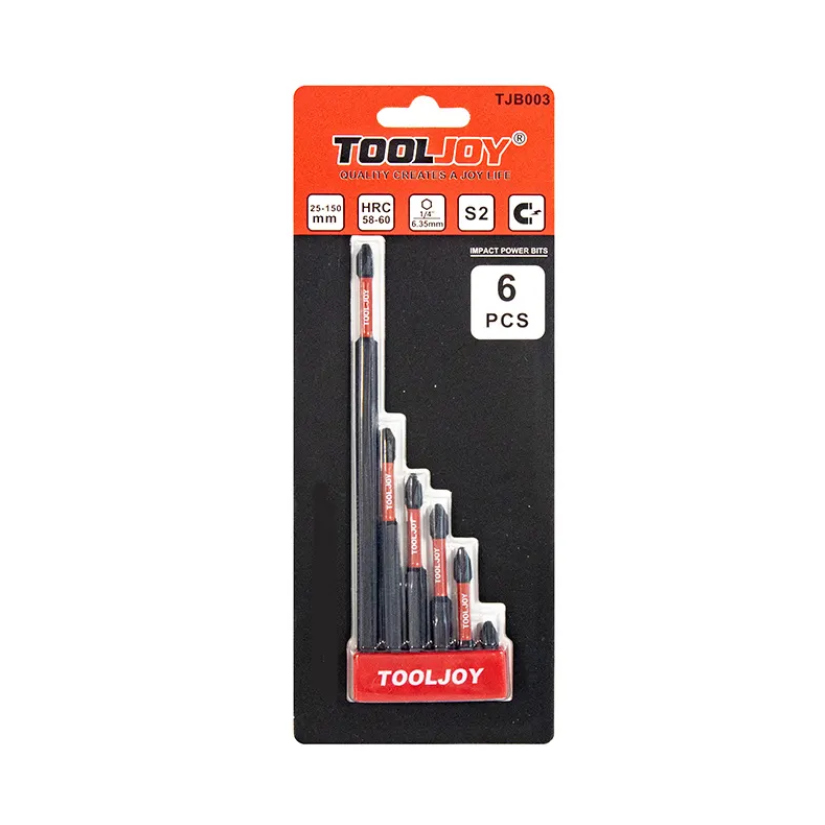
Tooljoy 6PCS Magnetic Impact Power Bit Set – 25–150mm S2 Steel, Phillips, for Impact Drivers | View on Tooljoypro.com
Double-Ended Bits: A Productivity Multiplier
Double-ended impact driver bits — featuring the same or different profiles at each end — are an excellent value proposition for high-volume drivers. When one end wears out, the bit is simply flipped rather than discarded, effectively doubling the working life of each piece. For professional tradespeople driving hundreds of screws per day, this translates to a significant reduction in the frequency of bit changes and the consumable cost per year. Double-ended PH2 bits in 65 mm length are particularly popular in drywall and decking trades where PH2 is the overwhelmingly dominant drive type.
Some double-ended designs combine two different profiles — for example, PH2 on one end and PZ2 on the other — providing versatility without requiring a separate bit. While these combination bits sacrifice some tip optimization at each end compared to single-profile designs, they are highly practical for tradespeople who work across multiple fastener types in the same session.
Drywall Applications: The Depth-Stop Advantage
For drywall installation specifically, bits with integrated depth-stop collars are a productivity game-changer. These bits are designed to drive screws to the precise depth required for code-compliant drywall fastening — the screw head must be set just below the surface without breaking the paper facing — automatically stopping driving when the correct depth is reached. This eliminates the need for the operator to visually judge depth on every single fastener, dramatically reducing installation time and the number of over-driven screws that require patching.
Final Guidance
Building a comprehensive impact driver bit collection is not a one-time purchase — it is an evolving toolkit that grows with your work. Start with a core set covering the drive types and lengths most relevant to your primary trade, then add specialized bits (security Torx, Robertson, extra-long extensions, depth-stop drywall bits) as specific job requirements demand them. Prioritize S2 steel, proper heat treatment, and magnetic tips in every purchase, and you will have bits that consistently perform at the highest professional level regardless of the application.